
Premarket Price Action
US equity futures are mixed after Tuesday’s advance, with technology continuing to outperform as broader participation wanes. The market approaches today’s FOMC decision and tonight’s hyperscaler earnings, with AI leadership intact but on an increasingly narrow foundation.
THIS WILL BE THE ONLY NOTE POSTED TODAY.
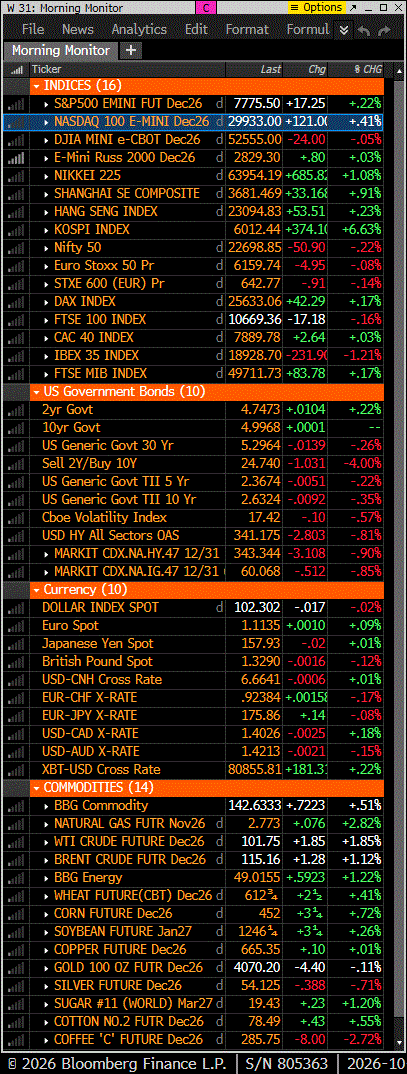
US equity futures: S&P 500: +0.2%; Nasdaq: +0.4%; Russell 2000: -0.1%; Dow: -0.1%
Treasuries: Rates are flat ahead of the FOMC decision.
Dollar: Dollar Index is flat.
Crypto: Bitcoin +0.25%.
Commodities: Gold -0.20%, silver -0.80%, WTI crude +1.80%. Natural gas +2.7%
Overnight – Global Markets
Asia: South Korea’s KOSPI surged 6.63%, led by an 11% advance in SK Hynix following strong earnings and an exceptionally bullish outlook for memory demand. Taiwan gained 2.04%, Japan’s Nikkei advanced 1.08%, and Shenzhen rose 1.98%. The continued strength in Asian semiconductor markets reinforces the concentration of global equity leadership in AI infrastructure.
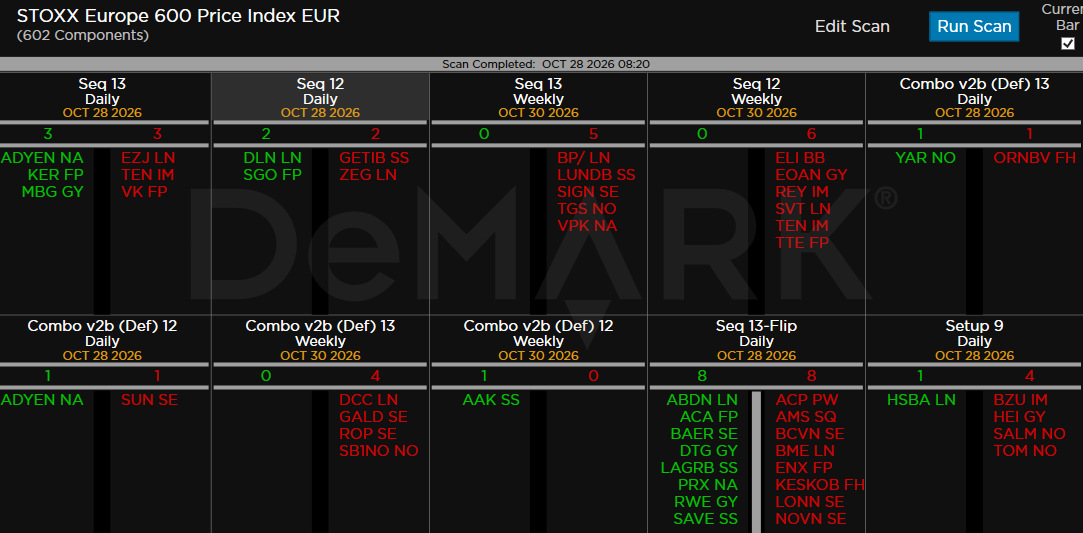
Europe: Major indices are down approximately 0.15–0.20%. Autos, telecoms, energy, and semiconductors are outperforming, while basic resources, chemicals, banks, insurance, and real estate lag. ASM International, Deutsche Bank, Standard Chartered, Stellantis, and Heineken are higher following earnings. Adyen, BASF, GSK, Logitech, UBS, Santander, and Unilever are weaker.
Premarket Setup and What’s Driving Markets
Tuesday’s advance extended the recovery in AI-related equities, with the Nasdaq gaining 1.29% and the S&P rising 0.61%. However, breadth was slightly negative despite strength in semiconductors, the Magnificent Seven, industrials, airlines, cruise lines, and biotechnology. The divergence between index performance and underlying participation is becoming more important as investors prepare for the largest concentration of earnings catalysts this week.
– AI fundamentals remain exceptionally strong, but expectations are increasingly demanding. SK Hynix’s results and long-term supply agreements reinforce the structural memory shortage, while Seagate, Teradyne, and NXP delivered generally positive results that were nevertheless met with more restrained reactions. The gap between strong fundamentals and what share prices already reflect is becoming more pronounced.
– The semiconductor trade continues to dominate global leadership. SK Hynix expects memory demand to exceed supply through 2030, with agreements covering more than 50% of production capacity in 2027 and 2028. The durability of those commitments is supportive, but the concentration of equity performance in this theme increases vulnerability to even modest disappointments.
– AI chip competition is expanding. OpenAI reportedly plans to purchase Google’s TPUs, while Oracle will offer TPU capacity to outside customers. This broadens Google’s opportunity beyond its own cloud business and introduces another competitive consideration for Nvidia and other accelerator suppliers.
– Geopolitical risk is keeping energy prices elevated. The White House has reportedly advised Gulf allies to prepare for a possible short, intense military campaign against Iran following the midterm elections. A resumption of hostilities is increasingly anticipated, raising the possibility that some of the risk premium in crude could unwind if military action is delayed or proves less disruptive than feared.
– The next test is earnings rather than the Fed. Microsoft and Alphabet report tonight, followed by Amazon tomorrow. Cloud revenue, backlog conversion, AI monetization, and the financing requirements behind continued capital spending will determine whether the recent recovery in technology shares can extend.
Macro & Policy Focus
FOMC Decision – 2:00 PM ET
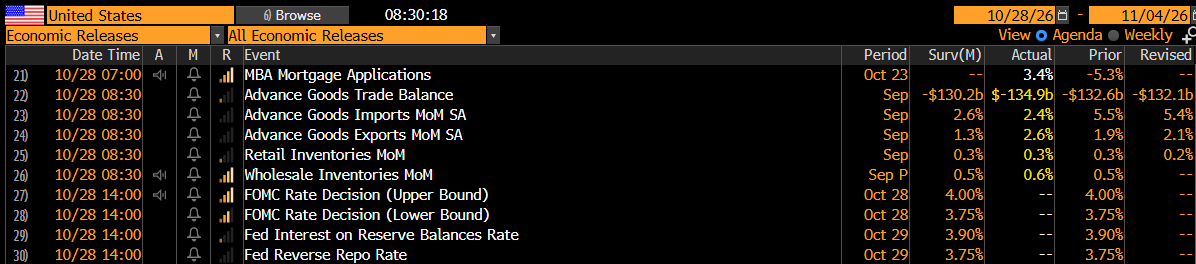
The Fed is widely expected to leave rates unchanged, with Chair Warsh’s press conference beginning at 2:30 PM. The Fed will not update the Summary of Economic Projections, and markets do not expect meaningful forward guidance. The decision could include dissents, but the focus will be on how the Fed balances resilient growth against persistent inflation and higher energy costs.
Markets still expect additional tightening in December and March. The greater risk is that stronger growth or renewed inflation pressure reinforces those expectations when equity valuations remain elevated.
Today’s data: Trade balance and wholesale inventories.
Thursday: Q3 GDP and PCE inflation are the week’s most consequential macro releases, alongside a $44B seven-year Treasury auction.
Friday: Employment Cost Index.
Strong AI investment, elevated crude prices, and persistent inflation concerns complicate the case for lower rates. For equities, the question is whether earnings growth can continue to offset restrictive monetary policy.
Company, Sector Movers, Earnings summary
AI, Semiconductors and Technology
– SKHY (SK Hynix): Earnings beat, with management expecting memory demand to exceed supply through 2030. Long-term agreements with 14 major customers cover more than 50% of production capacity for 2027–2028, supporting visibility into future pricing and demand. The company also announced $75B in capital returns. Exceptionally strong fundamentals, although the magnitude of the stock’s advance raises the bar for continued upside.
– STX (Seagate): FQ1 EPS of $7.68 beat $7.39, with revenue of $4.2B and gross margins of 57.8% ahead of expectations. FQ2 guidance of $9.20 EPS and $4.8B revenue was also above consensus. Strong demand and improving profitability, but expectations were already elevated following Western Digital’s results.
– TER (Teradyne): Q3 EPS of $2.29 beat $2.09, with revenue of $1.306B ahead of $1.268B. Q4 guidance also exceeded expectations, but the magnitude of the upside was not sufficient to satisfy investors following the recent rally. Another example of strong fundamentals meeting a high valuation bar.
– FFIV (F5): FQ4 EPS of $4.42 beat $4.23, with revenue of $917M ahead of $885M. Added $1.5B to its buyback authorization, but FQ1 EPS guidance of $4.31 fell below $4.38 expectations. Solid execution, with forward profitability tempering enthusiasm.
– NXPI (NXP Semiconductors): Results and commentary were generally constructive, but expectations had increased following Texas Instruments’ earnings. The market is becoming less willing to reward results that merely meet elevated expectations.
– GOOGL (Alphabet): Google’s TPU business is gaining momentum as Oracle becomes the first major outside cloud provider to offer TPU capacity, while OpenAI reportedly plans direct purchases. This creates an increasingly credible alternative to Nvidia’s ecosystem and expands Google’s potential AI infrastructure revenue opportunity.
– BKR (Baker Hughes): Q3 EPS of $0.70 beat $0.61, with revenue of $8B ahead of $7.71B. Book-to-bill reached 1.35x, supported by strength in oilfield services and industrial energy technology, where orders surged 42% year over year on data center demand. Q4 guidance was broadly in line. A strong report with improving exposure to AI infrastructure investment.
Industrials, Infrastructure and Energy
– GEV (GE Vernova): Q3 EBITDA of $1.9B beat $1.68B, with revenue up 27% to $12.6B and margins expanding 690 basis points. Orders surged 96% organically to $29B, producing a 2.3x book-to-bill ratio. Full-year revenue guidance increased to $47B, with EBITDA margins raised to 14%. Outstanding headline results, although Power drove most of the upside while Electrification orders declined 9% organically. The divergence between segments is worth monitoring.
– GNRC (Generac): EPS of $2.54 beat $2.43, but revenue of $1.295B missed $1.324B, with commercial and industrial sales falling short. Full-year revenue guidance was unchanged, while margin expectations improved modestly. Not a poor report, but the absence of stronger C&I demand is disappointing given enthusiasm surrounding power infrastructure.
– PPG (PPG Industries): Q3 EPS of $2.25 beat $2.12, with revenue of $4.35B ahead of $4.27B. Full-year EPS guidance increased to an $8.00 midpoint from $7.90. Solid execution and improving profitability.
– CR (Crane): Beat and raised guidance, supported by stronger organic growth and margins in Process Flow Technologies. A constructive read-through for industrial demand and operating leverage.
– WM (Waste Management): EPS of $2.15 missed $2.18, with EBITDA of $2.121B below $2.161B. Revenue exceeded expectations, but weaker margins offset the sales upside. Full-year guidance was maintained. Stable demand, but limited operating leverage.
Financials, Consumer and Other Sectors
– V (Visa): FQ4 EPS of $3.48 modestly exceeded $3.44, with revenue up 13% to $12.13B. However, FY27 EPS guidance was slightly below expectations. Healthy transaction fundamentals, but the forward outlook limits the upside.
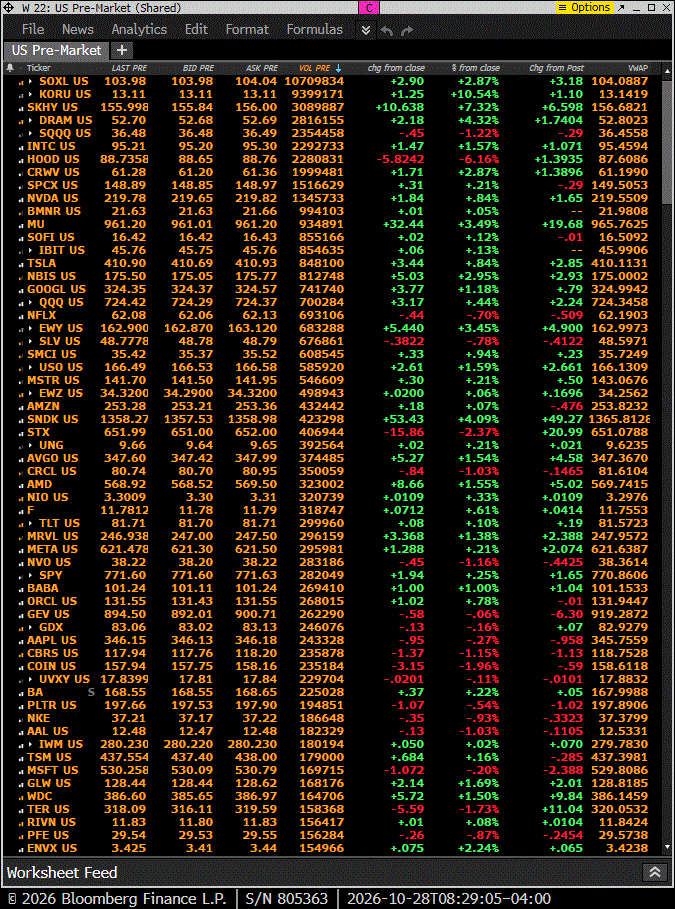
– HOOD (Robinhood): EPS of $0.60 beat $0.57, with EBITDA of $808M ahead of $772M. Revenue of $1.42B narrowly missed expectations, while softer September operating metrics weighed on sentiment. The market is focusing more on activity trends than the quarterly earnings beat.
– BXP (BXP): FFO of $1.89 beat $1.81, supported by better portfolio performance. Full-year FFO guidance increased by $0.05 at the midpoint. A constructive result for office real estate, although broader financing conditions remain important.
– CAKE (Cheesecake Factory): Comparable sales surged 15.2%, well ahead of 9.5% expectations, while EPS of $1.02 beat $0.95. Management’s more cautious forward commentary overshadowed the strong quarter. The market is questioning how much of the recent demand strength can be sustained.
– ENPH (Enphase Energy): Significant earnings miss and sharply weaker Q4 guidance, with high rates, inventory pressure, and regulatory uncertainty weighing on the outlook. The solar sector remains challenged despite broader interest in power infrastructure.
– LOGI (Logitech): Logistics inflation pressured margins, offsetting otherwise reasonable operating performance.
– CSGP (CoStar): Net new bookings fell short, raising questions about near-term sales momentum.
– UHS (Universal Health Services): EBITDA missed expectations, with startup costs creating profitability headwinds.
Key S&P 500 Upgrades / Downgrades
Upgrades
- PNR (Pentair): Raised to Neutral, BNP Paribas; PT $65.
- TXN (Texas Instruments): Raised to Hold, DZ Bank; PT $300.
Downgrades
- BA (Boeing): Cut to Neutral, President Capital Management; PT $192.
- FFIV (F5): Cut to Neutral, Piper Sandler; PT $461.
- XYL (Xylem): Cut to Underweight, JPMorgan; PT $90.
Initiations
– MRVL (Marvell Technology): Initiated Buy, SPDB International HK; PT $303.
What We’re Watching Today:
– Microsoft and Alphabet earnings: Cloud growth, AI revenue conversion, backlog, and capital spending guidance will determine whether the recent technology rally has sufficient fundamental support. Alphabet’s TPU momentum adds another dimension to the competitive landscape.
– Breadth versus index performance: The Nasdaq continues to outperform, but Tuesday’s negative breadth is a warning. We want participation to broaden beyond semiconductors and the Magnificent Seven, not another session of concentrated leadership.
– Sentiment and volatility: S&P bullish sentiment at 62% and Nasdaq at 65% reflect a meaningful rebuilding of positioning. VIX bullish sentiment at 21% is approaching an extreme bearish reading, suggesting investors are becoming less concerned about volatility immediately ahead of major catalysts.
– FOMC and energy: Watch the market’s reaction to Warsh’s inflation commentary and the possibility of renewed military operations against Iran. Crude bullish sentiment has retreated from extreme levels but remains elevated at 77%, leaving meaningful two-way risk around geopolitical developments.
Bottom Line: The AI trade continues to deliver exceptional fundamental results, but the market is increasingly distinguishing between strong earnings and results that justify elevated valuations. Sentiment has recovered rapidly while breadth remains uneven, making tonight’s hyperscaler earnings particularly important. The rally can continue, but it needs broader participation and confirmation that AI monetization can keep pace with the extraordinary capital being committed.
market snapshot
economic reports today
premarket trading
US MARKET SENTIMENT
S&P 500 bullish sentiment rose 6 points to 62% after Tuesday’s 0.61% advance. Sentiment has recovered above its 20-day average of 59.70% and remains comfortably above the important 50% midpoint. This is a constructive improvement, although it also reduces the positioning cushion that existed before the recent rebound.
Nasdaq bullish sentiment rose 6 points to 65%, and the index gained 1.29%. Sentiment has risen 10 points over the last two sessions and is now just 3.70 points below its 20-day average of 68.70%. The recovery in technology positioning has been rapid, leaving less room for further sentiment-driven upside without continued fundamental confirmation.
VIX bullish sentiment declined 2 points to 21%, as the VIX fell 9.64% to 17.52. Sentiment remains close to the extreme bearish threshold below 20%, suggesting investors are again becoming less concerned about near-term volatility. This deserves attention given the concentration of earnings and geopolitical catalysts immediately ahead.
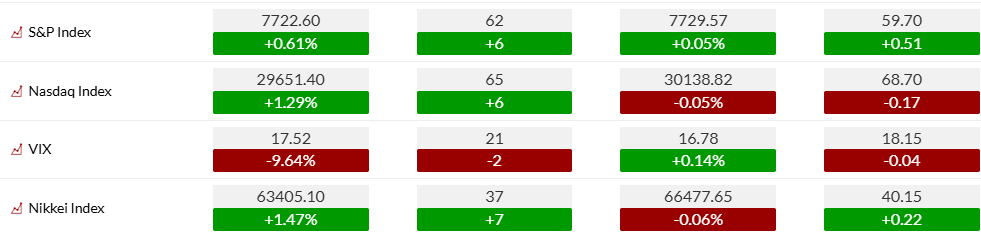
Rates: Bullish sentiment in the 10-year Treasury rate remains at 28%, while the 30-year is unchanged at 42%. Both remain below the 50% midpoint despite the recent rise in rates. The 10-year reading is 8.40 points below its 20-day average, suggesting positioning has not embraced a sustained move higher in rates.

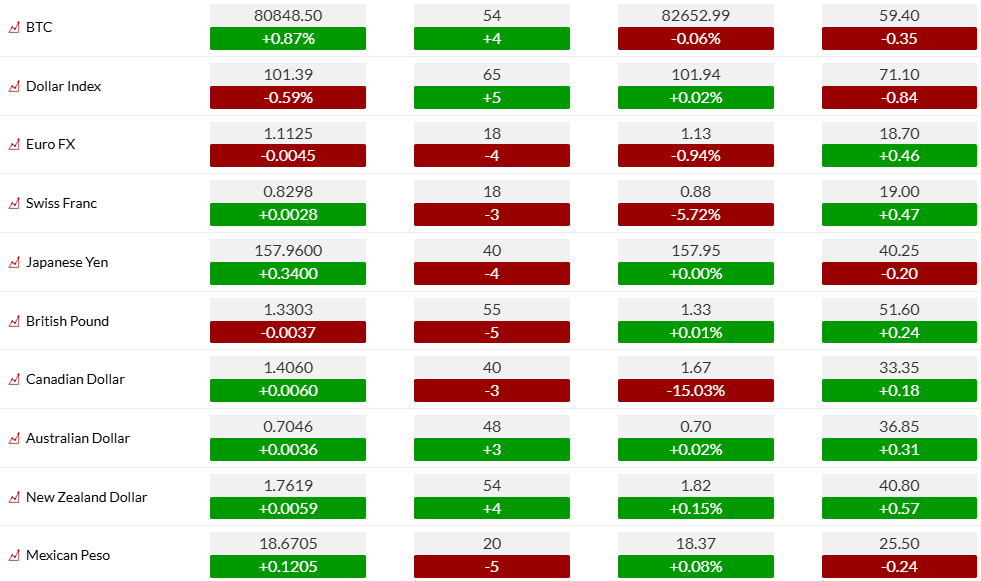
FX: Dollar bullish sentiment increased another 5 points to 65%, despite the Dollar Index declining 0.59% in the monitor. Sentiment is now 6.10 points below its 20-day average of 71.10%. The dollar’s bullish positioning continues to rebuild even as price action has softened.
The euro fell 4 points to 18% bullish sentiment, entering extreme bearish territory. The Swiss franc also stands at 18%, while the Mexican peso declined 5 points to 20%. Sterling lost 5 points to 55%. The broad pattern reflects continued preference for the dollar over European currencies, although the divergence between dollar sentiment and price warrants monitoring.
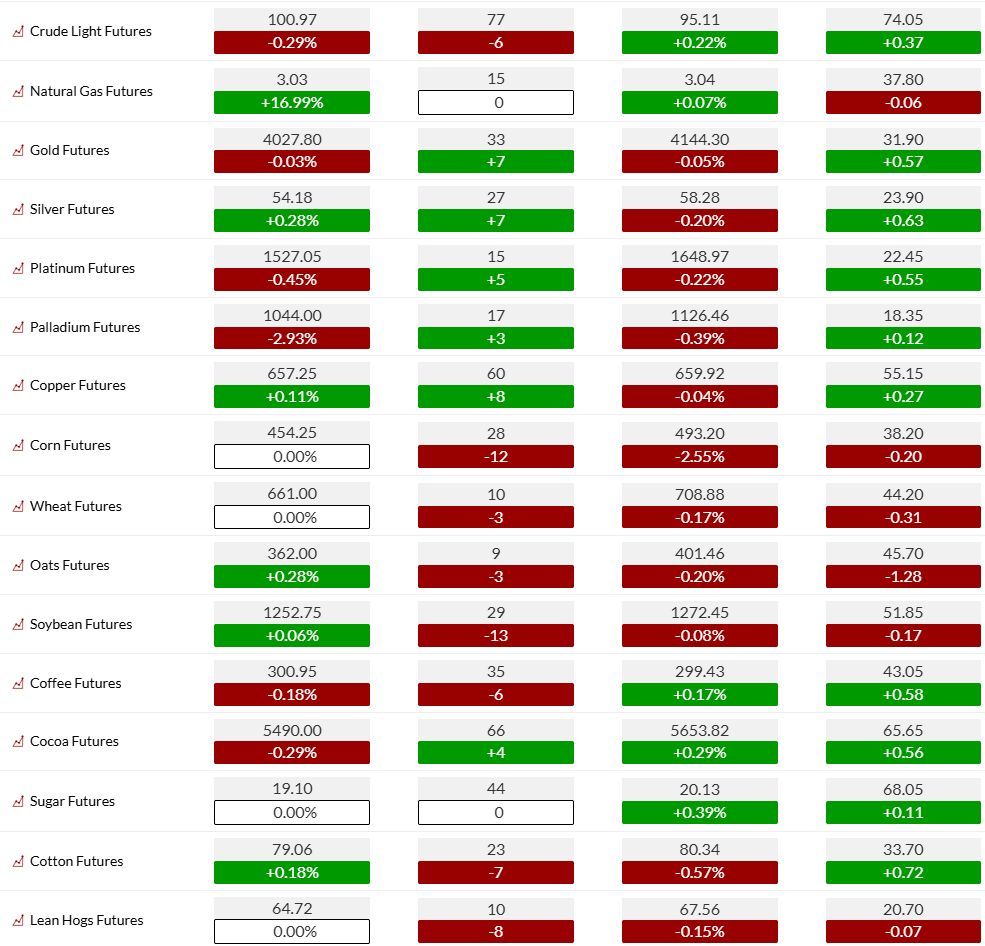
Crude oil: Bullish sentiment declined 6 points to 77%, moving below the extreme bullish threshold of 80%. Despite the pullback, sentiment remains elevated and 2.95 points above its 20-day average. The recent decline in bullish positioning while geopolitical risk remains elevated suggests some investors are taking profits rather than adding exposure. Natural gas: Bullish sentiment remains at 15%, an extreme bearish reading and 22.80 points below its 20-day average of 37.80%. Natural gas rallied 16.99% in the latest monitor without an accompanying improvement in sentiment. This is a notable divergence and leaves potential for additional short-covering or mean reversion.
Gold: Bullish sentiment increased 7 points to 33%, although it remains 1.10 points above its 20-day average. Positioning is recovering from depressed levels but remains below the 50% midpoint. Silver: Bullish sentiment increased 7 points to 27%, still 3.10 points above its 20-day average. The recovery remains early, with sentiment still relatively subdued despite the improvement.
Copper: Bullish sentiment increased 8 points to 60%, moving further above the midpoint and 4.85 points above its 20-day average. This is one of the stronger commodity sentiment improvements and is consistent with renewed interest in industrial exposure.
Agriculture: Corn sentiment fell 12 points to 28%, while soybeans declined 13 points to 29%. Cotton lost 7 points to 23%, and lean hogs declined 8 points to 10%. These are among the largest negative sentiment changes across the commodity complex.
US MARKETS
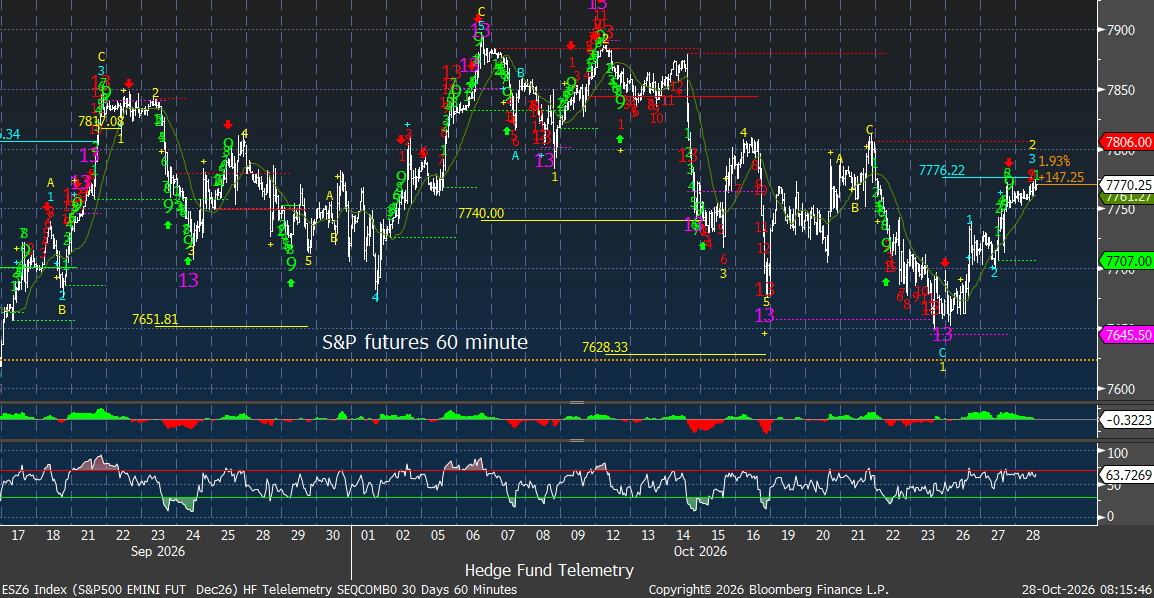
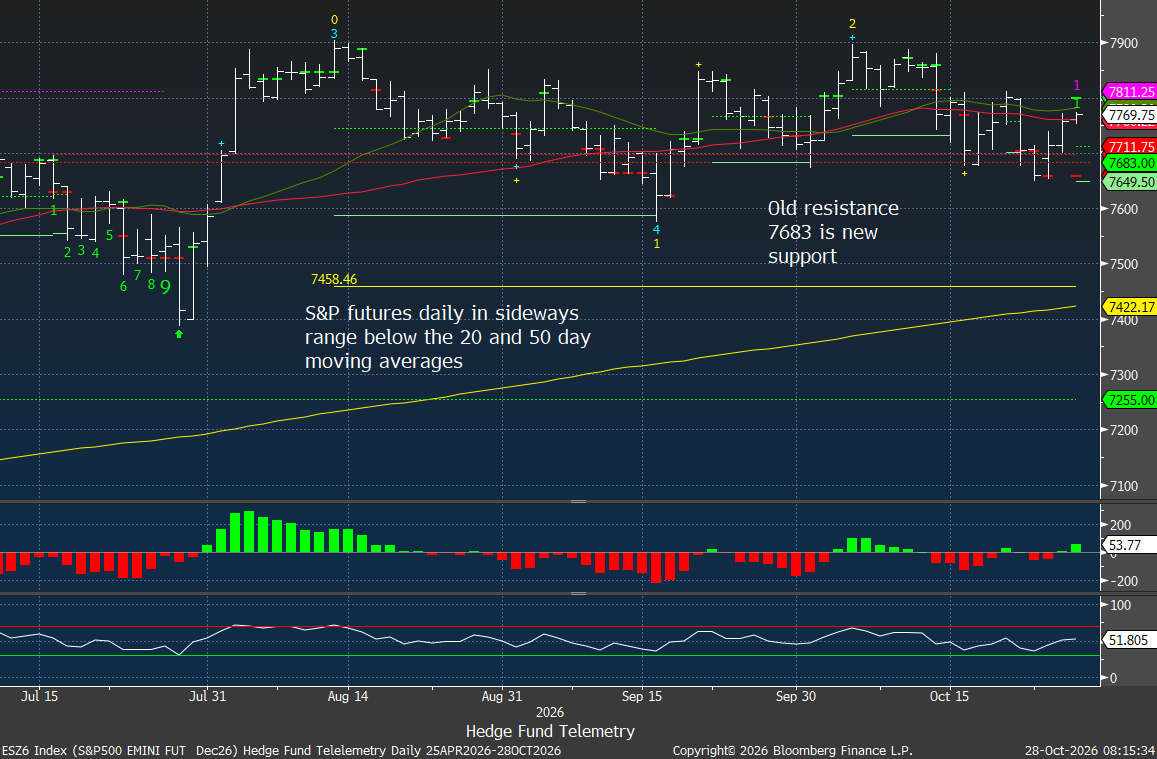
S&P futures 60-minute tactical time frame bounced after recent Sequential and Combo 13’s at upside wave 3 price objective. More important level to watch is TDST Setup Trend resistance at 7806
S&P futures daily remains in sideways range
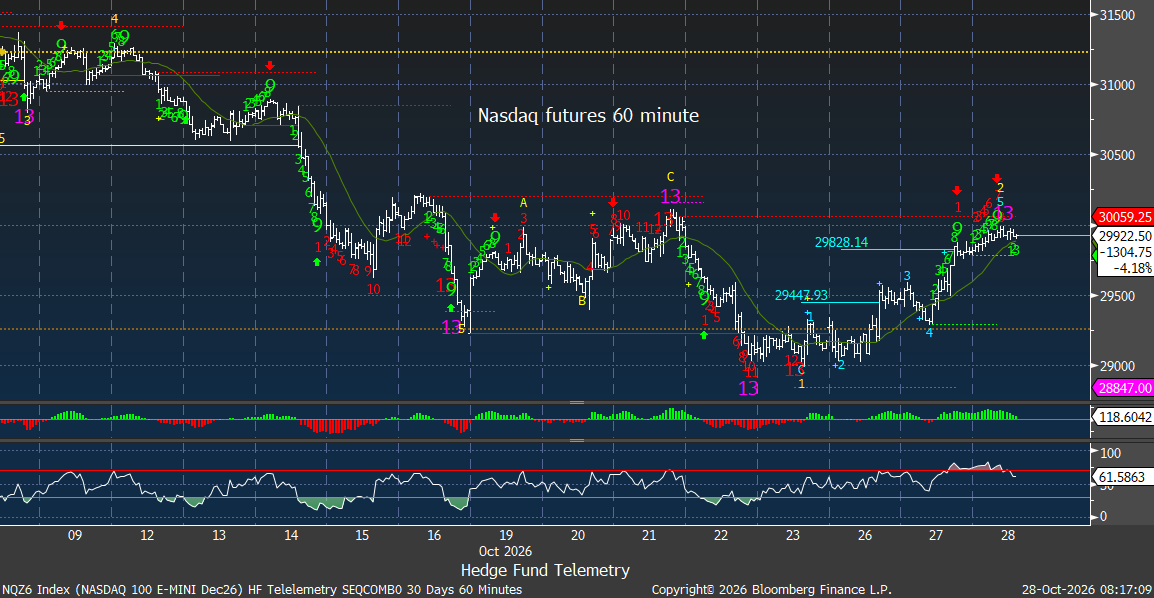
Nasdaq 100 60-minute tactical time frame lifted higher in 5 waves above the wave 5 price objective with a new Sell Setup 9 and Combo 13. Sequential on hour bar 7 of 13. The corrective lower high wave 2 of 5 pattern remains as I said yesterday at times in sideways markets both upside and downside wave patterns can work at the same time.
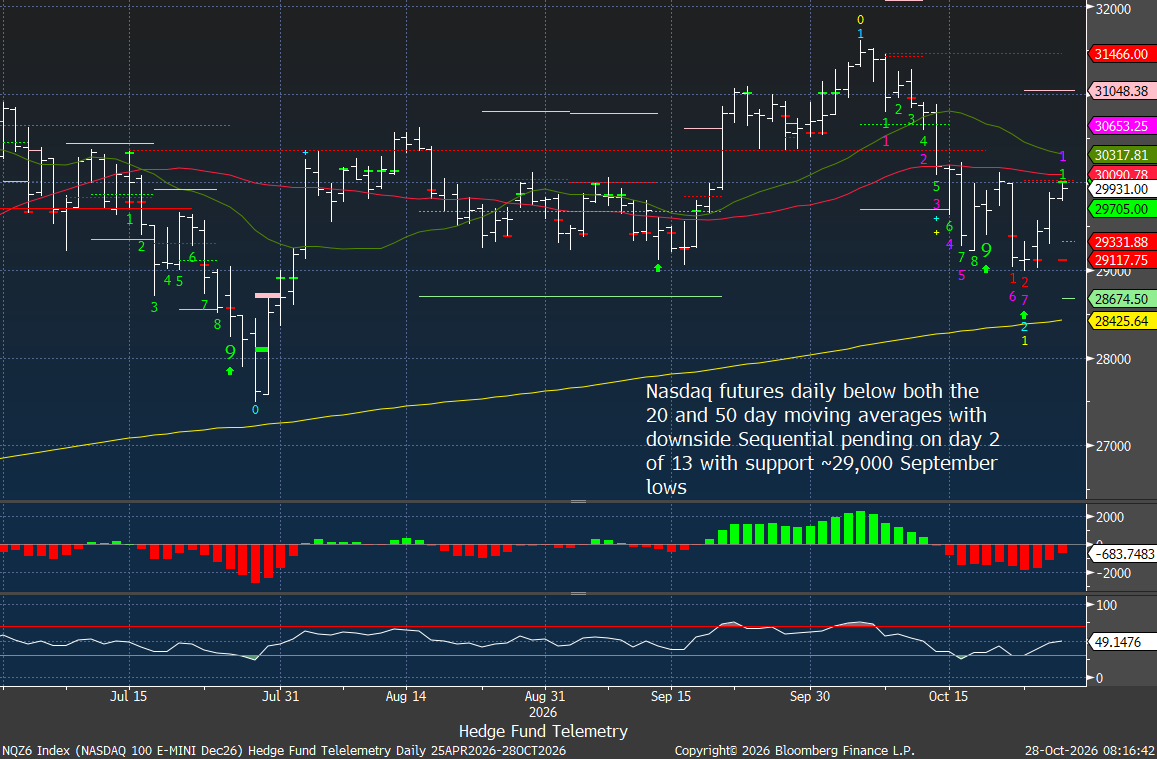
Nasdaq 100 futures daily bouncing to just under the 50 day. Watching for corrective wave 2 of 5 lower high bounce to qualify with an 8 day closing high.
Extra charts we’re watching
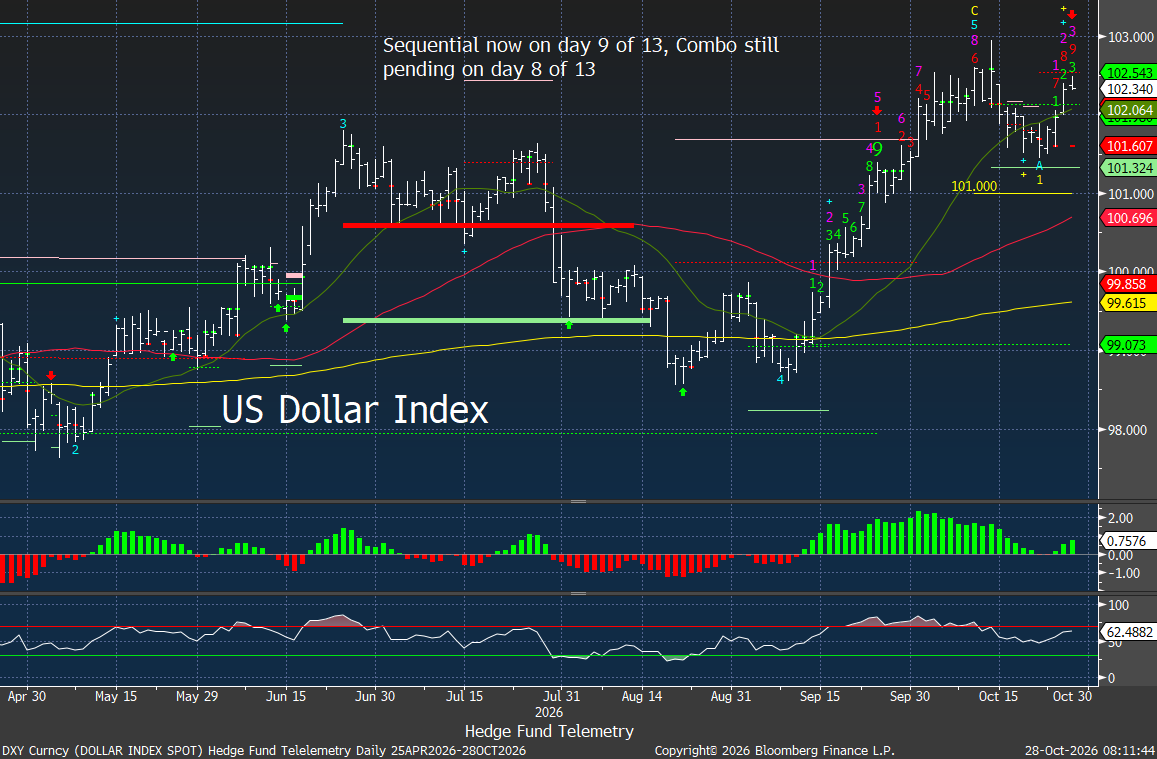
US Dollar Index daily still rising with Sequential on day 9 of 13
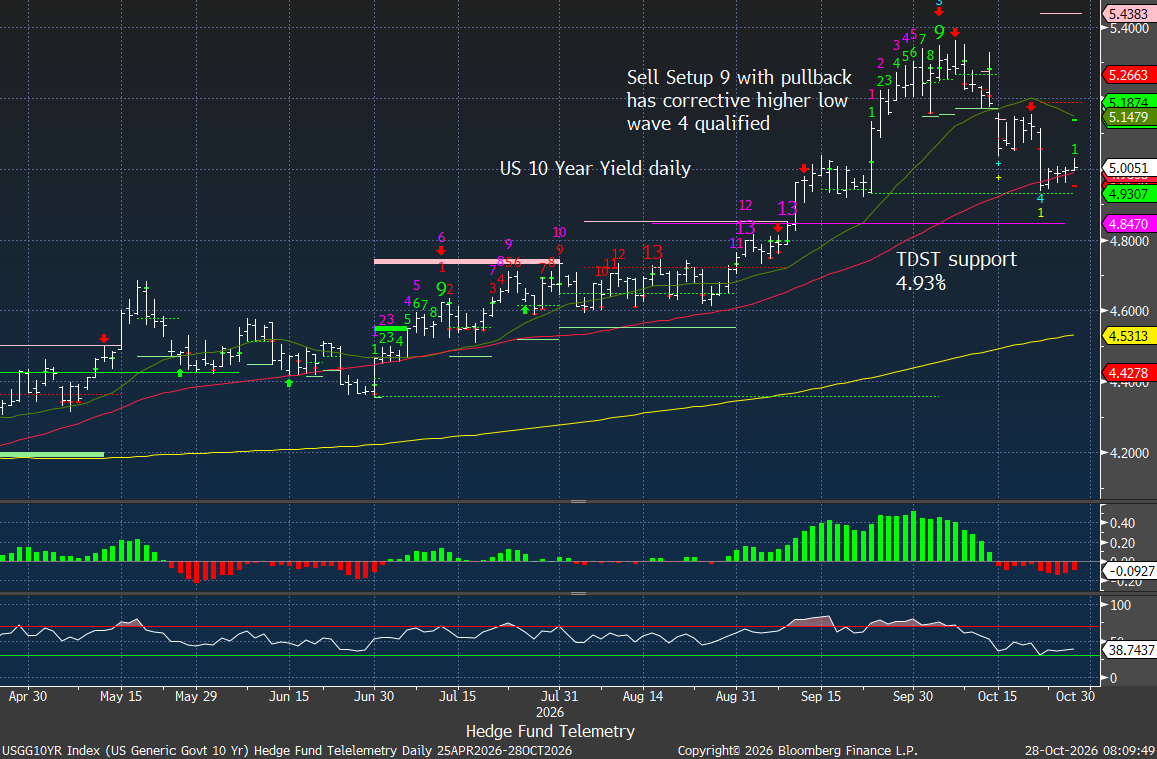
US 10-Year Yield holding the 50 day at 5%
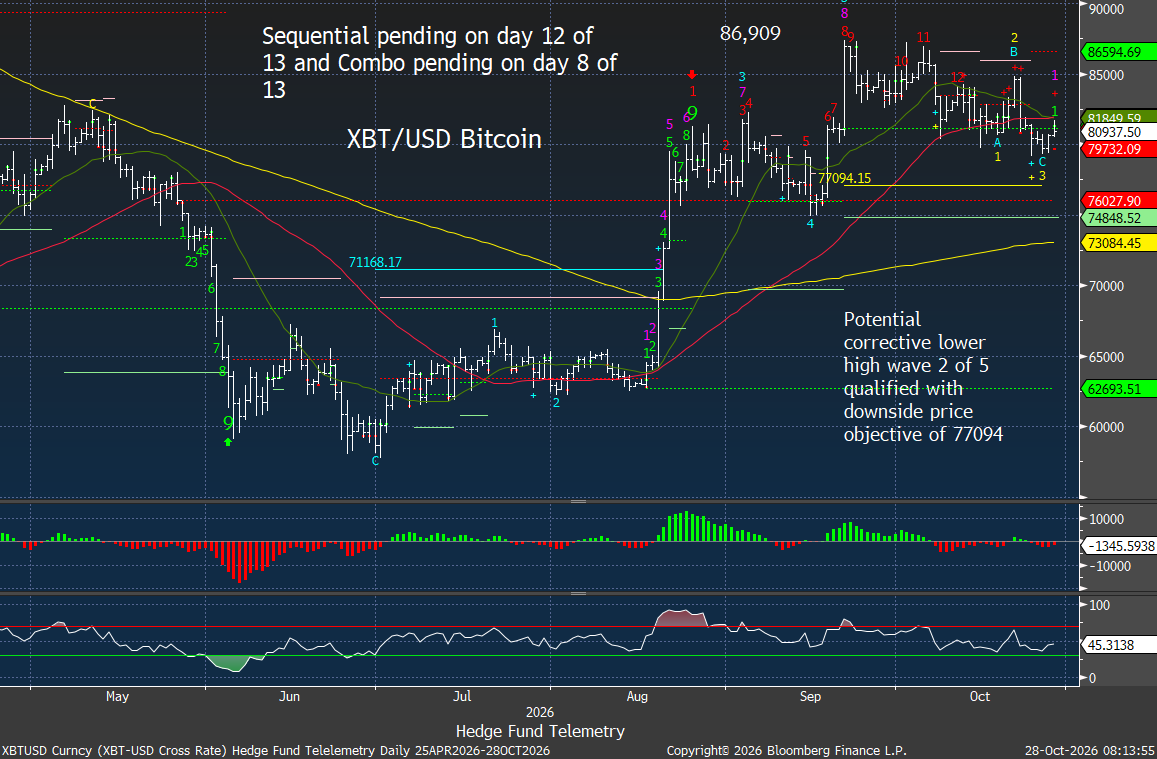
Bitcoin Daily bounced off yesterday’s low lost the downside Setup that was on day 5 of 9. Sequential on upside remains pending on day 12 of 13 with a close over the 8th red bar close of 86,909 required for the 13
DeMark Observations – Euro Stoxx 600